
Showing posts with label honda. Show all posts
Showing posts with label honda. Show all posts
Thursday, March 1, 2012

Tuesday, February 21, 2012
Norton and Honda 4 cylinders motorcycle engines
.
Last week we received a photo taken at George 'Norton' Cohens workshop showing his latest restoration, the 100th Manx Norton Special with Daytona engine. Upon closer inspection of the photo I detected an intruder of Japanese origin, what could this mean?
Has george had an alarming and sudden change of heart?

Here's George Answer:
For the past 35 years I have messed around with single cylinder Norton machines in side-valve, over-head valve and single and double over-head cam configuration. I have rebuilt, repaired and wrecked hundreds of them; all in the quest for more power and reliability. I have also read with interest over the same period of time numerous articles pertaining to the experimental 4 cylinder engine of the early fifties. Up until very recently, I had always lamented the fact that this engine was never seen fighting the multi-cylinder machines from MV, Gillera and Honda. That was until a few months ago, but first a pre-amble to my story.
Manx Nortons dominated motorcycle racing before and after the second world war, but by 1950 the Italian 4 cylinder engines were becoming a considerable threat to the trusty single cylinder unit.
“Tony” Vandervell, who was part of the works Norton Isle of Man TT racing team in the early twenties (along side Murray Walker’s father, Graham), was Nortons major shareholder after WW II and he also had a great passion for racing cars. He was one of the major financial backers of BRM and commissioned them to develop a watercooled double over head cam four cylinder, 500cc engine for Norton in 1951. Numerous problems relating to engineering design failures, personality clashes and finally financial cut backs meant that the project failed, for three main reasons.
Firstly, BRM failed to take into consideration the need to mount the engine in a motorcycle frame and the development was brought back to the experimental department at Bracebridge St, Birmingham. Here, Leo Kuzmicki, who was a former Polish fighter pilot, was found to be sweeping the floor far too slowly for the likes of the head of the department, a fiery Irishman and tuning maestro, Joe Craig. After a good telling off, Craig was told that this floor sweeper was a senior lecture on internal combustion engines at Warsaw University before the war. Soon, Kuzmicki was put into the drawing office where his genius on cam profiles, combustion chamber shapes, valve timing and porting soon paid dividends on the Manx engine, especially the 350 cc version. He also started work on the 4 cylinder engine.
Secondly, Vandervell fell out with Raymond Mays at BRM and subsequently continued to develop his Thinwall specials, named after his very successful closed caged ‘Thin-wall’ bearings business.
Thirdly, as a consequence of Nortons financial difficulties they were bought by Associated Motorcycles (AMC) in 1953. The financial backers at AMC were appalled at how such a large slice of the cake was being put into the racing machines to the detriment of developing better machines for the road. They pulled the plug on the racing department. No more works team, no more works machines and finally no more Leo Kuzmicki, who was given a much larger wage packet by Vandervell at his new venture the Vanwall Specials. It is ironic that the 2 litre Vanwall engine was essentially four 500 cc Manx Norton engines on a common crankcase.
So Norton did try with a multi cylinder machine and the prototype engine and drawings can be seen at Sammy Miller’s museum, but I am now bloody glad that it never materialized.
Why the change of mind, you may ask?
Last summer a conversation with my 23 year old daughter, Camilla, went along the lines of:
“Dad, my bike has not got lights and sometimes it wont start”.
“That ‘s about par for a thirties 350 Norton International, live with it”.
“I’ve seen a 1972 Honda 500 4 on ebay, its got lights and an electric start”
“Oh no!”
Too cut a long story short, a week later we had this motorcycle in the shed. Camilla rode it for 900 miles over the next few months and I even had a ride down to the seaside on it. Not as fast as a 500 International and a lot heavier, but at least it started every time and you could stay late at the pub, because of the reliable lighting system.
So far so good, but the next week the oil pressure light remained on and to my untrained ear the engine sounded like the proverbial bag of nails. So we bought a Haynes manual, a set of metric spanners and a good bottle of wine and proceeded to pull the thing apart. A hundred hours later, struggling with thousands of cross head 6 mm bolts, primary thrunging sprockets, bizarre gear change mechanisms, tiny little gudgeon pin circlips which were flying around the shed as we snapped at them with tweezers and a manual which even the most intelligent of grease monkeys could not follow we had the bloody engine down to its bare bones.
I could not find a fault anywhere! All journals, shafts and ‘wot-nots, miked’ up to the manufacturers specification. Another million hours later we managed to get it all back together and squeezed it back into the frame. According to my research on Google and at the local Bike Club, it is apparently almost impossible to get the four carbs onto the inlet manifold rubbers and air box at the same time without resorting to a combination of wooden wedges, big hammers and plenty of Vaseline. To my surprise, my daughter and I managed to do this within the hour and eventually the heavy machine was taken out of the shed and replenished with fresh oil. It worked perfectly, the oil light went off and the engine sounded sweet.
So far this Honda engine has consumed the time it would take me to build a trillion Manx Norton engines and we never did find out the problem. Perhaps it was just a faulty switch, which would have taken just a few hours to replace, instead of weeks of work.
So the moral of this story ends with the thought: Would I have been able to spanner a four cylinder Norton engine?
Perhaps with practice I might have of got the hang of it, but I am mighty pleased that a Manx Norton engine has only got one piston, two valves and Whitworth nuts and bolts.

Last week we received a photo taken at George 'Norton' Cohens workshop showing his latest restoration, the 100th Manx Norton Special with Daytona engine. Upon closer inspection of the photo I detected an intruder of Japanese origin, what could this mean?
Has george had an alarming and sudden change of heart?

Here's George Answer:
For the past 35 years I have messed around with single cylinder Norton machines in side-valve, over-head valve and single and double over-head cam configuration. I have rebuilt, repaired and wrecked hundreds of them; all in the quest for more power and reliability. I have also read with interest over the same period of time numerous articles pertaining to the experimental 4 cylinder engine of the early fifties. Up until very recently, I had always lamented the fact that this engine was never seen fighting the multi-cylinder machines from MV, Gillera and Honda. That was until a few months ago, but first a pre-amble to my story.
Manx Nortons dominated motorcycle racing before and after the second world war, but by 1950 the Italian 4 cylinder engines were becoming a considerable threat to the trusty single cylinder unit.
“Tony” Vandervell, who was part of the works Norton Isle of Man TT racing team in the early twenties (along side Murray Walker’s father, Graham), was Nortons major shareholder after WW II and he also had a great passion for racing cars. He was one of the major financial backers of BRM and commissioned them to develop a watercooled double over head cam four cylinder, 500cc engine for Norton in 1951. Numerous problems relating to engineering design failures, personality clashes and finally financial cut backs meant that the project failed, for three main reasons.
Firstly, BRM failed to take into consideration the need to mount the engine in a motorcycle frame and the development was brought back to the experimental department at Bracebridge St, Birmingham. Here, Leo Kuzmicki, who was a former Polish fighter pilot, was found to be sweeping the floor far too slowly for the likes of the head of the department, a fiery Irishman and tuning maestro, Joe Craig. After a good telling off, Craig was told that this floor sweeper was a senior lecture on internal combustion engines at Warsaw University before the war. Soon, Kuzmicki was put into the drawing office where his genius on cam profiles, combustion chamber shapes, valve timing and porting soon paid dividends on the Manx engine, especially the 350 cc version. He also started work on the 4 cylinder engine.
Secondly, Vandervell fell out with Raymond Mays at BRM and subsequently continued to develop his Thinwall specials, named after his very successful closed caged ‘Thin-wall’ bearings business.
Thirdly, as a consequence of Nortons financial difficulties they were bought by Associated Motorcycles (AMC) in 1953. The financial backers at AMC were appalled at how such a large slice of the cake was being put into the racing machines to the detriment of developing better machines for the road. They pulled the plug on the racing department. No more works team, no more works machines and finally no more Leo Kuzmicki, who was given a much larger wage packet by Vandervell at his new venture the Vanwall Specials. It is ironic that the 2 litre Vanwall engine was essentially four 500 cc Manx Norton engines on a common crankcase.
So Norton did try with a multi cylinder machine and the prototype engine and drawings can be seen at Sammy Miller’s museum, but I am now bloody glad that it never materialized.
Why the change of mind, you may ask?
Last summer a conversation with my 23 year old daughter, Camilla, went along the lines of:
“Dad, my bike has not got lights and sometimes it wont start”.
“That ‘s about par for a thirties 350 Norton International, live with it”.
“I’ve seen a 1972 Honda 500 4 on ebay, its got lights and an electric start”
“Oh no!”
Too cut a long story short, a week later we had this motorcycle in the shed. Camilla rode it for 900 miles over the next few months and I even had a ride down to the seaside on it. Not as fast as a 500 International and a lot heavier, but at least it started every time and you could stay late at the pub, because of the reliable lighting system.
So far so good, but the next week the oil pressure light remained on and to my untrained ear the engine sounded like the proverbial bag of nails. So we bought a Haynes manual, a set of metric spanners and a good bottle of wine and proceeded to pull the thing apart. A hundred hours later, struggling with thousands of cross head 6 mm bolts, primary thrunging sprockets, bizarre gear change mechanisms, tiny little gudgeon pin circlips which were flying around the shed as we snapped at them with tweezers and a manual which even the most intelligent of grease monkeys could not follow we had the bloody engine down to its bare bones.
I could not find a fault anywhere! All journals, shafts and ‘wot-nots, miked’ up to the manufacturers specification. Another million hours later we managed to get it all back together and squeezed it back into the frame. According to my research on Google and at the local Bike Club, it is apparently almost impossible to get the four carbs onto the inlet manifold rubbers and air box at the same time without resorting to a combination of wooden wedges, big hammers and plenty of Vaseline. To my surprise, my daughter and I managed to do this within the hour and eventually the heavy machine was taken out of the shed and replenished with fresh oil. It worked perfectly, the oil light went off and the engine sounded sweet.
So far this Honda engine has consumed the time it would take me to build a trillion Manx Norton engines and we never did find out the problem. Perhaps it was just a faulty switch, which would have taken just a few hours to replace, instead of weeks of work.
So the moral of this story ends with the thought: Would I have been able to spanner a four cylinder Norton engine?
Perhaps with practice I might have of got the hang of it, but I am mighty pleased that a Manx Norton engine has only got one piston, two valves and Whitworth nuts and bolts.

Friday, February 17, 2012
Motorcycle Picture of the Week - Ray Latta

Tuesday, May 24, 2011
2011 Honda Shadow Aero VT750
2011 Honda Shadow Aero VT750 Review
 2011 Honda Shadow Aero VT750 1
 2011 Honda Shadow Aero VT750 2
 2011 Honda Shadow Aero VT750 3
2011 Honda Shadow Aero VT750 - United States of America Specifications
USA MSRP - $TBA USD
Model: VT750
Engine Type: 745cc liquid-cooled 52° V-twin
Bore and Stroke: 79mm x 76mm
Compression ratio: 9.6:1
Valve Train: SOHC; three valves per cylinder
Induction: PGM-FI with automatic enrichment circuit, one 34mm throttle body
Ignition: Digital transistorized with electronic advance
Transmission: Wide-ratio five-speed
Final Drive: Shaft
Suspension
Front: 41mm fork; 4.6 inches travel
Rear: Dual shocks with five-position spring preload adjustability; 3.5 inches travel
Brakes
Front: Single 296mm disc with twin-piston caliper
Rear: 180mm drum
Tires
Front: 120/90-17
Rear: 160/80-15
Wheelbase: 64.5 inches
Rake (Caster angle): 34°
Trail: 161mm (6.3 inches)
Seat Height: 25.9 inches
Fuel Capacity: 3.7 gallons, including 0.9-gallon reserve
Estimated Fuel Economy: 56 mpg
Color: Candy Dark Red
Curb Weight*: 553 pounds
*Includes all standard equipment, required fluids and full tank of fuel-ready to ride.
Honda's fuel economy estimates are based on EPA exhaust emission measurement test procedures and are intended for comparison purposes only. Your actual mileage will vary depending on how you ride, how you maintain your vehicle, weather, road conditions, tire pressure, installation of accessories, cargo, rider and passenger weight, and other factors.
Meets current EPA standards.
Models sold in California meet current CARB standards and may differ slightly due to emissions equipment
2011 Honda Shadow Aero VT750 - Canadian Specifications
Canada MSRP - $TBA CDN
TBA
2011 Honda Shadow Aero VT750 is one motorcycle issued by the manufacturer Honda with Streetfighterbike edition which supported the body design is comfortable to use. 2011 Honda Shadow Aero VT750 used Suspension Front: 41mm fork; 4.6 inches travel and rear: Dual shocks with five-position spring preload adjustability; 3.5 inches travel. For brake is used Single 296mm disc with twin-piston caliper for front brake and for rear brake used 180mm drum. This 2011 Honda Shadow Aero VT750 has a engine capacity 745 cc with Bore x stroke: 79mm x 76mm and with engine type 745cc liquid-cooled 52° V-twin.
 2011 Honda Shadow Aero VT750 1
 2011 Honda Shadow Aero VT750 2
 2011 Honda Shadow Aero VT750 3
2011 Honda Shadow Aero VT750 - United States of America Specifications
USA MSRP - $TBA USD
Model: VT750
Engine Type: 745cc liquid-cooled 52° V-twin
Bore and Stroke: 79mm x 76mm
Compression ratio: 9.6:1
Valve Train: SOHC; three valves per cylinder
Induction: PGM-FI with automatic enrichment circuit, one 34mm throttle body
Ignition: Digital transistorized with electronic advance
Transmission: Wide-ratio five-speed
Final Drive: Shaft
Suspension
Front: 41mm fork; 4.6 inches travel
Rear: Dual shocks with five-position spring preload adjustability; 3.5 inches travel
Brakes
Front: Single 296mm disc with twin-piston caliper
Rear: 180mm drum
Tires
Front: 120/90-17
Rear: 160/80-15
Wheelbase: 64.5 inches
Rake (Caster angle): 34°
Trail: 161mm (6.3 inches)
Seat Height: 25.9 inches
Fuel Capacity: 3.7 gallons, including 0.9-gallon reserve
Estimated Fuel Economy: 56 mpg
Color: Candy Dark Red
Curb Weight*: 553 pounds
*Includes all standard equipment, required fluids and full tank of fuel-ready to ride.
Honda's fuel economy estimates are based on EPA exhaust emission measurement test procedures and are intended for comparison purposes only. Your actual mileage will vary depending on how you ride, how you maintain your vehicle, weather, road conditions, tire pressure, installation of accessories, cargo, rider and passenger weight, and other factors.
Meets current EPA standards.
Models sold in California meet current CARB standards and may differ slightly due to emissions equipment
2011 Honda Shadow Aero VT750 - Canadian Specifications
Canada MSRP - $TBA CDN
TBA
Monday, May 16, 2011
2011 Honda Interstate VT1300CT
2011 Honda Interstate VT1300CT Review
 2011 Honda Interstate VT1300CT 1
 2011 Honda Interstate VT1300CT 2
 2011 Honda Interstate VT1300CT 3
 2011 Honda Interstate VT1300CT 4
 2011 Honda Interstate VT1300CT 5
2011 Honda Interstate VT1300CT is one motorcycle issued by the manufacturer Honda with Streetfighterbike edition which supported the body design is comfortable to use. 2011 Honda Interstate VT1300CT has a engine capacity 1312 cc with Bore x stroke: 89.5mm x 104.3mm and with engine type 1312cc liquid-cooled 52° V-twin.
 2011 Honda Interstate VT1300CT 1
 2011 Honda Interstate VT1300CT 2
 2011 Honda Interstate VT1300CT 3
 2011 Honda Interstate VT1300CT 4
 2011 Honda Interstate VT1300CT 5
2011 Honda Interstate VT1300CT - United States of America Specifications
USA MSRP - $TBA USD
Model: VT1300CT
Engine Type: 1312cc liquid-cooled 52° V-twin
Bore and Stroke: 89.5mm x 104.3mm
Compression ratio: 9.2:1
Valve Train: SOHC; three valves per cylinder
Induction: PGM-FI with automatic enrichment circuit, one 38mm throttle body
Ignition: Digital with 3-D mapping, two spark plugs per cylinder
Transmission: Five-speed
Final Drive: Shaft
Suspension Front: 41mm fork; 4.0 inches travel
Rear: Single shock; 3.9 inches travel
Brakes Front: Single 336mm disc with twin-piston caliper
Rear: 296mm disc with single-piston caliper
Optional ABS and CBS will be available - color TBD
Tires Front: 140/80-17
Rear: 170/80-15
Wheelbase: 70.3 inches
Rake (Caster angle): 33.0°
Trail: 118.0mm (4.6 inches)
Seat Height: 26.8 inches
Fuel Capacity: 4.4 gallons
Estimated Fuel Economy**: 47 mpg
Colors: Dark Red Metallic, Black
Curb Weight* 712 pounds
*Includes all standard equipment, required fluids and full tank of fuel--ready to ride.
**Honda's fuel-economy estimates are based on EPA exhaust emission measurement test procedures and are intended for comparison purposes only. Your actual mileage will vary depending on how you ride; how you maintain your vehicle; weather; road conditions; tire pressure; installation of accessories; cargo, rider and passenger weight; and other factors.
Meets current EPA standards.
Models sold in California meet current CARB standards and may differ slightly due to emissions equipment.
2011 Honda Interstate VT1300CT - Canadian Specifications
Canada MSRP - $TBA CDN
TBA
USA MSRP - $TBA USD
Model: VT1300CT
Engine Type: 1312cc liquid-cooled 52° V-twin
Bore and Stroke: 89.5mm x 104.3mm
Compression ratio: 9.2:1
Valve Train: SOHC; three valves per cylinder
Induction: PGM-FI with automatic enrichment circuit, one 38mm throttle body
Ignition: Digital with 3-D mapping, two spark plugs per cylinder
Transmission: Five-speed
Final Drive: Shaft
Suspension Front: 41mm fork; 4.0 inches travel
Rear: Single shock; 3.9 inches travel
Brakes Front: Single 336mm disc with twin-piston caliper
Rear: 296mm disc with single-piston caliper
Optional ABS and CBS will be available - color TBD
Tires Front: 140/80-17
Rear: 170/80-15
Wheelbase: 70.3 inches
Rake (Caster angle): 33.0°
Trail: 118.0mm (4.6 inches)
Seat Height: 26.8 inches
Fuel Capacity: 4.4 gallons
Estimated Fuel Economy**: 47 mpg
Colors: Dark Red Metallic, Black
Curb Weight* 712 pounds
*Includes all standard equipment, required fluids and full tank of fuel--ready to ride.
**Honda's fuel-economy estimates are based on EPA exhaust emission measurement test procedures and are intended for comparison purposes only. Your actual mileage will vary depending on how you ride; how you maintain your vehicle; weather; road conditions; tire pressure; installation of accessories; cargo, rider and passenger weight; and other factors.
Meets current EPA standards.
Models sold in California meet current CARB standards and may differ slightly due to emissions equipment.
2011 Honda Interstate VT1300CT - Canadian Specifications
Canada MSRP - $TBA CDN
TBA
Thursday, May 12, 2011
2011 Honda Fury ABS VT1300CXA
2011 Honda Fury ABS VT1300CXA Review
 2011 Honda Fury ABS VT1300CXA 1
 2011 Honda Fury ABS VT1300CXA 2
 2011 Honda Fury ABS VT1300CXA 3
 2011 Honda Fury ABS VT1300CXA 3
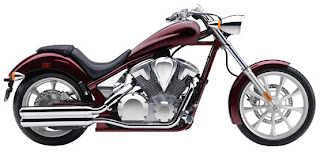 2011 Honda Fury ABS VT1300CXA 5
2011 Honda Fury ABS VT1300CXA - United States of America Specifications
USA MSRP - $TBA USD
Model: VT1300CX ABS
Engine Type: 1312cc liquid-cooled 52° V-twin
Bore and Stroke: 89.5mm x 104.3mm
Compression ratio: 9.2:1
Valve Train: SOHC; three valves per cylinder
Induction: PGM-FI with automatic enrichment circuit, one 38mm throttle body
Ignition: Digital with 3-D mapping,two spark plugs per cylinder
Transmission: Five-speed
Final Drive: Shaft
Suspension
Front: 45mm fork; 4.0 inches travel
Rear: Single shock with adjustable rebound damping and five-position spring preload adjustability; 3.7 inches travel
Brakes
Front: Single 336mm disc with twin-piston caliper
Rear: 296mm disc with single-piston caliper
Optional ABS and CBS will be available - color TBD
Tires
Front: 90/90-21
Rear: 200/50-18
Wheelbase: 71.2 inches
Rake (Caster angle): 32°
Trail: 92mm (3.6 inches)
Seat Height: 26.7 inches
Fuel Capacity: 3.4 gallons
Estimated Fuel Economy**: 46 mpg
Colors: Dark Red Metallic, Pearl White, Matte Orange Metallic
Curb Weight*: 681 pounds (VT1300CX ABS)
*Includes all standard equipment, required fluids and full tank of fuel-ready to ride.
**Honda's fuel-economy estimates are based on EPA exhaust emission measurement test procedures and are intended for comparison purposes only. Your actual mileage will vary depending on how you ride; how you maintain your vehicle; weather; road conditions; tire pressure; installation of accessories; cargo, rider and passenger weight; and other factors.
Meets current EPA standards.
Models sold in California meet current CARB standards and may differ slightly due to emissions equipment.
2011 Honda Fury ABS VT1300CXA - Canadian Specifications
Canada MSRP - $TBA CDN
TBA
2011 Honda Fury ABS VT1300CXA is one motorcycle issued by the manufacturer Honda with Streetfighterbike edition which supported the body design is comfortable to use. 2011 Honda Fury ABS VT1300CXA used Suspension Front: 45mm fork; 4.0 inches travel and Rear: Single shock with adjustable rebound damping and five-position spring preload adjustability; 3.7 inches travel. For brake is used Single 336mm disc with twin-piston caliper for front brake and for rear bike used 296mm disc with single-piston caliper. This 2011 Honda Fury ABS VT1300CXA has a engine capacity 1312 cc with Bore x stroke: 89.5mm x 104.3mm and with engine type 1312cc liquid-cooled 52° V-twin.
 2011 Honda Fury ABS VT1300CXA 1
 2011 Honda Fury ABS VT1300CXA 2
 2011 Honda Fury ABS VT1300CXA 3
 2011 Honda Fury ABS VT1300CXA 3
 2011 Honda Fury ABS VT1300CXA 5
2011 Honda Fury ABS VT1300CXA - United States of America Specifications
USA MSRP - $TBA USD
Model: VT1300CX ABS
Engine Type: 1312cc liquid-cooled 52° V-twin
Bore and Stroke: 89.5mm x 104.3mm
Compression ratio: 9.2:1
Valve Train: SOHC; three valves per cylinder
Induction: PGM-FI with automatic enrichment circuit, one 38mm throttle body
Ignition: Digital with 3-D mapping,two spark plugs per cylinder
Transmission: Five-speed
Final Drive: Shaft
Suspension
Front: 45mm fork; 4.0 inches travel
Rear: Single shock with adjustable rebound damping and five-position spring preload adjustability; 3.7 inches travel
Brakes
Front: Single 336mm disc with twin-piston caliper
Rear: 296mm disc with single-piston caliper
Optional ABS and CBS will be available - color TBD
Tires
Front: 90/90-21
Rear: 200/50-18
Wheelbase: 71.2 inches
Rake (Caster angle): 32°
Trail: 92mm (3.6 inches)
Seat Height: 26.7 inches
Fuel Capacity: 3.4 gallons
Estimated Fuel Economy**: 46 mpg
Colors: Dark Red Metallic, Pearl White, Matte Orange Metallic
Curb Weight*: 681 pounds (VT1300CX ABS)
*Includes all standard equipment, required fluids and full tank of fuel-ready to ride.
**Honda's fuel-economy estimates are based on EPA exhaust emission measurement test procedures and are intended for comparison purposes only. Your actual mileage will vary depending on how you ride; how you maintain your vehicle; weather; road conditions; tire pressure; installation of accessories; cargo, rider and passenger weight; and other factors.
Meets current EPA standards.
Models sold in California meet current CARB standards and may differ slightly due to emissions equipment.
2011 Honda Fury ABS VT1300CXA - Canadian Specifications
Canada MSRP - $TBA CDN
TBA
Saturday, May 7, 2011
2011 Honda Fury VT1300CX
2011 Honda Fury VT1300CX Review
 2011 Honda Fury VT1300CX 1
 2011 Honda Fury VT1300CX 2
 2011 Honda Fury VT1300CX 3
 2011 Honda Fury VT1300CX 4
 2011 Honda Fury VT1300CX 5
2011 Honda Fury VT1300CX - United States of America Specifications
USA MSRP - $TBA USD
Model: VT1300CX
Engine Type: 1312cc liquid-cooled 52° V-twin
Bore and Stroke: 89.5mm x 104.3mm
Compression ratio: 9.2:1
Valve Train: SOHC; three valves per cylinder
Induction: PGM-FI with automatic enrichment circuit, one 38mm throttle body
Ignition: Digital with 3-D mapping,two spark plugs per cylinder
Transmission: Five-speed
Final Drive: Shaft
Suspension
Front: 45mm fork; 4.0 inches travel
Rear: Single shock with adjustable rebound damping and five-position spring preload adjustability; 3.7 inches travel
Brakes
Front: Single 336mm disc with twin-piston caliper
Rear: 296mm disc with single-piston caliper
Optional ABS and CBS will be available - color TBD
Tires
Front: 90/90-21
Rear: 200/50-18
Wheelbase: 71.2 inches
Rake (Caster angle): 32°
Trail: 92mm (3.6 inches)
Seat Height: 26.7 inches
Fuel Capacity: 3.4 gallons
Estimated Fuel Economy**: 46 mpg
Colors: Dark Red Metallic, Pearl White, Matte Orange Metallic
Curb Weight*: 663 pounds (VT1300CX)
*Includes all standard equipment, required fluids and full tank of fuel-ready to ride.
**Honda's fuel-economy estimates are based on EPA exhaust emission measurement test procedures and are intended for comparison purposes only. Your actual mileage will vary depending on how you ride; how you maintain your vehicle; weather; road conditions; tire pressure; installation of accessories; cargo, rider and passenger weight; and other factors.
Meets current EPA standards.
Models sold in California meet current CARB standards and may differ slightly due to emissions equipment.
2011 Honda Fury VT1300CX - Canadian Specifications
Canada MSRP - $TBA CDN
TBA
2011 Honda Fury VT1300CX is one motorcycle issued by the manufacturer Honda with Streetfighterbike edition which supported the body design is comfortable to use. 2011 Honda Fury VT1300CX has a engine capacity 1312 cc with Bore x stroke: 89.5mm x 104.3mm and with engine type 1312cc liquid-cooled 52° V-twin.
 2011 Honda Fury VT1300CX 1
 2011 Honda Fury VT1300CX 2
 2011 Honda Fury VT1300CX 3
 2011 Honda Fury VT1300CX 4
 2011 Honda Fury VT1300CX 5
2011 Honda Fury VT1300CX - United States of America Specifications
USA MSRP - $TBA USD
Model: VT1300CX
Engine Type: 1312cc liquid-cooled 52° V-twin
Bore and Stroke: 89.5mm x 104.3mm
Compression ratio: 9.2:1
Valve Train: SOHC; three valves per cylinder
Induction: PGM-FI with automatic enrichment circuit, one 38mm throttle body
Ignition: Digital with 3-D mapping,two spark plugs per cylinder
Transmission: Five-speed
Final Drive: Shaft
Suspension
Front: 45mm fork; 4.0 inches travel
Rear: Single shock with adjustable rebound damping and five-position spring preload adjustability; 3.7 inches travel
Brakes
Front: Single 336mm disc with twin-piston caliper
Rear: 296mm disc with single-piston caliper
Optional ABS and CBS will be available - color TBD
Tires
Front: 90/90-21
Rear: 200/50-18
Wheelbase: 71.2 inches
Rake (Caster angle): 32°
Trail: 92mm (3.6 inches)
Seat Height: 26.7 inches
Fuel Capacity: 3.4 gallons
Estimated Fuel Economy**: 46 mpg
Colors: Dark Red Metallic, Pearl White, Matte Orange Metallic
Curb Weight*: 663 pounds (VT1300CX)
*Includes all standard equipment, required fluids and full tank of fuel-ready to ride.
**Honda's fuel-economy estimates are based on EPA exhaust emission measurement test procedures and are intended for comparison purposes only. Your actual mileage will vary depending on how you ride; how you maintain your vehicle; weather; road conditions; tire pressure; installation of accessories; cargo, rider and passenger weight; and other factors.
Meets current EPA standards.
Models sold in California meet current CARB standards and may differ slightly due to emissions equipment.
2011 Honda Fury VT1300CX - Canadian Specifications
Canada MSRP - $TBA CDN
TBA
Subscribe to:
Posts (Atom)